Calculate volume first, materials second
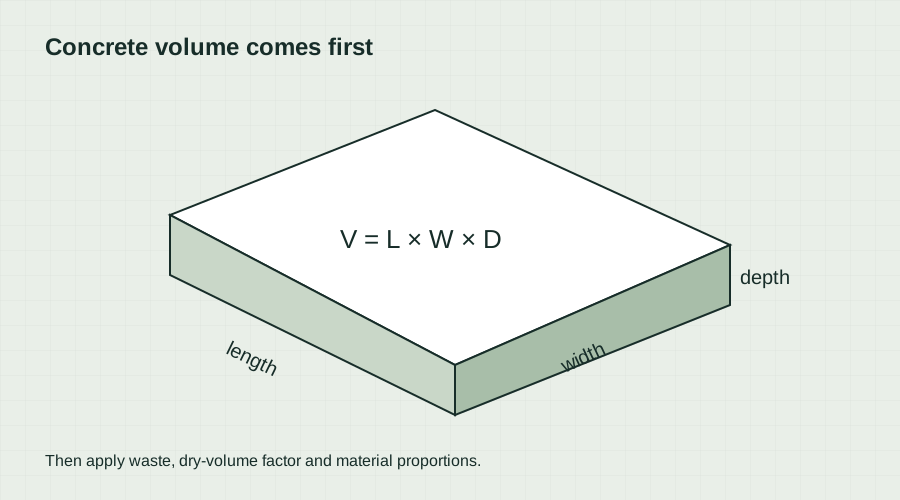
Select the geometry of the pour and enter the dimensions. Slabs use length, width and depth. A circular pour uses diameter and depth; the triangular option uses a perpendicular base and height; the trapezoid uses two parallel sides and their perpendicular separation. For an irregular project, split the plan into simple shapes or enter a measured custom volume.
Each length has its own unit selector. The calculator converts everything to metres before finding volume. Custom volume can be entered in cubic metres, cubic feet or cubic yards. Depth is a common source of error: 100 mm is 0.1 m, not 100 m.
Volume formulas by shape
| Shape | Volume |
|---|---|
| Rectangle / slab | length × width × depth |
| Square | side × side × depth |
| Cylinder | π × (diameter ÷ 2)² × depth |
| Triangle | base × perpendicular height ÷ 2 × depth |
| Trapezoid | (parallel side A + parallel side B) ÷ 2 × separation × depth |
After finding the wet volume, the calculator applies waste once. It then multiplies by the dry-volume factor and splits the result into the selected cement, sand and aggregate parts. These are loose dry-material volume proportions.
Dry material volume = order wet volume × 1.54
Each material volume = dry volume × its ratio part ÷ total parts
Each material mass = material volume × its bulk density
Cement bag equivalents = cement mass ÷ selected bag weight
A transparent M20 estimating example
Set Custom volume to 1 m³, waste to 0%, and the ratio to 1:1.5:3. The total is 5.5 parts. With a dry-volume factor of 1.54, the resulting quantities are 0.28 m³ cement, 0.42 m³ sand and 0.84 m³ aggregate.
At 1,440 kg/m³, the cement weighs 403.2 kg, equivalent to 8.064 bags of 50 kg. Rounding an order to whole bags gives 9 bags. Selecting 5% waste increases the cement estimate to 423.36 kg, the sand volume to 0.441 m³ and aggregate volume to 0.882 m³. The full calculation is explained in our M20 concrete ratio guide.
Mix-ratio reference and limitations
| Grade reference | Cement : sand : aggregate (loose dry volume) |
|---|---|
| M5 | 1 : 5 : 10 |
| M7.5 | 1 : 4 : 8 |
| M10 | 1 : 3 : 6 |
| M15 | 1 : 2 : 4 |
| M20 | 1 : 1.5 : 3 |
| M25 | Design mix required — no universal ratio |
| M30 | Design mix required — no universal ratio |
M5–M20 entries are conventional loose-volume estimating references. They do not guarantee a strength grade. M25 and M30 require a project-specific design mix, so no fixed-ratio presets are provided for those grades. Custom inputs also use loose dry volume: do not copy mass-based proportions from a mix-design report into these fields. A specified strength depends on the materials, water-to-cement ratio, production controls, placement and curing, not just a ratio selected on a website.
The default 1.54 factor is a preliminary planning assumption representing the difference between the loose dry ingredient volume and the consolidated concrete volume. It is not an extra waste percentage and it is not a universal measured yield. Change it if verified project data supports another factor.
The default loose bulk densities are 1,440 kg/m³ for cement, 1,600 kg/m³ for sand and 1,450 kg/m³ for aggregate. All can be changed. Moisture, grading, voids and compaction can shift actual densities substantially. Water, admixtures, reinforcement, formwork and labour are outside this material estimate.
Concrete calculator questions
Does 1:1.5:3 guarantee M20 strength?
No. A nominal ratio is an estimating convention. A structural mix needs the specified performance, suitable materials, local code compliance, quality control and appropriate testing.
Should I order cement and aggregate for ready-mixed concrete?
Usually you order ready-mixed concrete by finished volume and performance specification. Use the wet volume and discuss allowance, access, delivery schedule and specification with the producer; do not separately order these loose materials for the same pour.
Does the tool calculate water?
No. Water demand depends on moisture in the aggregates, workability, admixtures and the approved mix design. A fixed water estimate could be misleading.
Why do the dry ingredient volumes exceed the concrete volume?
Loose ingredients include voids. When combined, their volumes are not simply additive. The planning dry factor models that difference, with a separate allowance for project waste.