How to estimate a brick wall
Measure the net wall length, height and thickness. The calculator accepts a separate unit for each dimension, so you can enter a wall in feet and a brick in millimetres. Use the actual unit dimensions, not the dimensions of a brick plus its mortar joint. Joints are entered separately under Advanced options.
Subtract door and window openings by dividing the wall into solid rectangles and calculating each one. Add their unrounded material quantities before rounding an overall order. Do not include openings as solid brickwork. This calculator models a uniform solid wall; cavity walls, piers and mixed wall thicknesses need separate estimates.
Brick quantity and mortar formulas
Module volume = (brick length + joint) × (brick width + joint) × (brick height + joint)
Bricks = wall volume ÷ module volume
Order bricks = round up [bricks × (1 + waste ÷ 100)]
The three-dimensional module is an estimating approximation. It allocates a joint to each dimension of the brick, which is convenient for bulk quantities but does not reproduce the bond at the wall edges. A course-by-course layout is more useful for a small wall or a detailed cutting schedule.
Wet mortar is the difference between the wall volume and the actual volume occupied by the unrounded brick count. The estimate does not subtract the volume of the extra bricks ordered for waste. That would incorrectly reduce the mortar needed to build the wall.
Dry mortar materials = wet mortar × (1 + waste ÷ 100) × dry factor
Cement volume = dry mortar materials ÷ (1 + sand parts)
Sand volume = dry mortar materials × sand parts ÷ (1 + sand parts)
Worked example: a 3 m × 3 m wall
For a wall 3 m long, 3 m high and 100 mm thick, the volume is 0.9 m³. With bricks measuring 190 × 90 × 90 mm and 10 mm joints, each module occupies 0.002 m³. The estimate is 450 bricks before waste, or 473 bricks with 5% waste.
The bricks occupy 0.69255 m³, leaving 0.20745 m³ of wet mortar. With 5% allowance and the 1.33 dry factor, the dry material volume is 0.289703925 m³. At a 1:6 cement-to-sand ratio, this gives about 59.60 kg cement and 0.24832 m³ sand. Cement equals 1.192 of the selected 50 kg bags; purchasing whole bags requires 2. These numbers are estimates under the stated assumptions, not a specification for that wall.
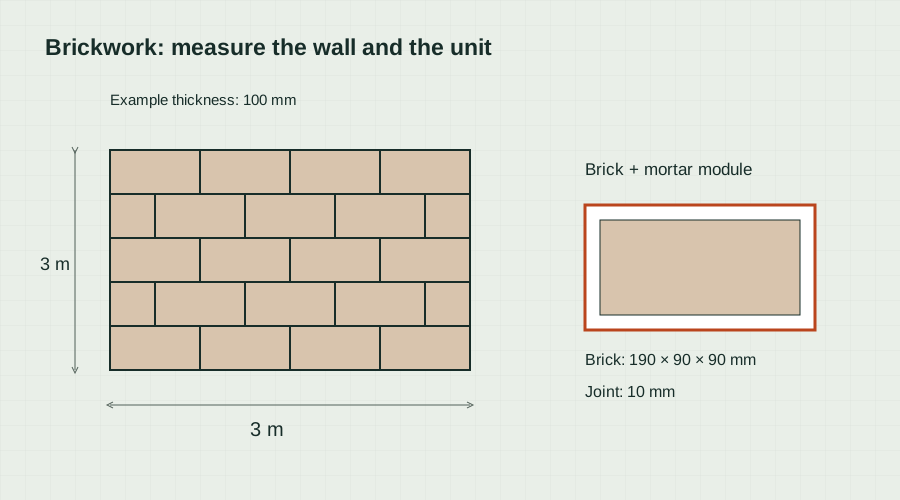
Brick sizes, joints and allowances
The presets below are examples, not universal standards. Dimensions vary between manufacturers and regions. Measure a sample or use the supplier’s current product data before estimating an order.
| Example brick size (mm) | How to use it |
|---|---|
| 190 × 90 × 90 | Default example; measure your actual brick |
| 194 × 92 × 57 | Preset for a smaller-height unit |
| 203.2 × 101.6 × 101.6 | 8 × 4 × 4 inch example |
| 215 × 102.5 × 65 | Example commonly used for estimates |
| 222 × 106 × 73 | Alternative preset |
| 228 × 107 × 69 | Alternative preset |
| 228.6 × 101.6 × 76.2 | 9 × 4 × 3 inch example |
| 228.6 × 114.3 × 63.5 | 9 × 4.5 × 2.5 inch example |
| 228.6 × 114.3 × 76.2 | 9 × 4.5 × 3 inch example |
| 230 × 110 × 76 | Alternative preset |
A thicker joint increases the module volume, reducing the number of bricks per cubic metre and increasing estimated mortar volume. Hollow units, frogs, perforations and mortar filling practices can change actual consumption. The model treats the brick’s outer dimensions as a solid volume and does not fill internal voids.
Default planning assumptions are 10 mm joints, a 1.33 dry mortar factor, cement bulk density of 1,440 kg/m³ and sand bulk density of 1,600 kg/m³. Each is editable. A 5% allowance is only a starting estimate for breakage, cutting and handling. Use a site-specific figure where your supplier or contractor has better information.
Material weight is volume multiplied by the selected bulk density. Bulk density includes the gaps between grains; it is not the same as the density of a solid cement particle. Sand moisture and compaction affect bulk density, so a mass estimate should be checked against the supplier’s delivery basis.
Brick calculator questions
Does this calculate a cavity wall?
Calculate each masonry leaf separately, excluding the cavity. This model does not estimate ties, insulation, lintels, reinforcement or structural capacity.
Is the wall thickness the same as brick width?
Sometimes, but not always. Enter the actual masonry thickness for your bond. Do not include render, plaster or insulation in the brick wall volume.
Why do whole cement bags look high for a small job?
Bag equivalents describe calculated consumption. The order figure rounds up to an entire bag; leftover material may be usable elsewhere on the project.
Can I set waste to zero?
Yes. Zero waste shows the theoretical model quantity. It does not account for broken units, cuts or mortar lost during work.